Kyoto Japanese Gardens in One Day: 4 Contrasting Styles for Group Trips in Kansai
Which Kyoto Japanese Gardens Are Worth Combining in One Day
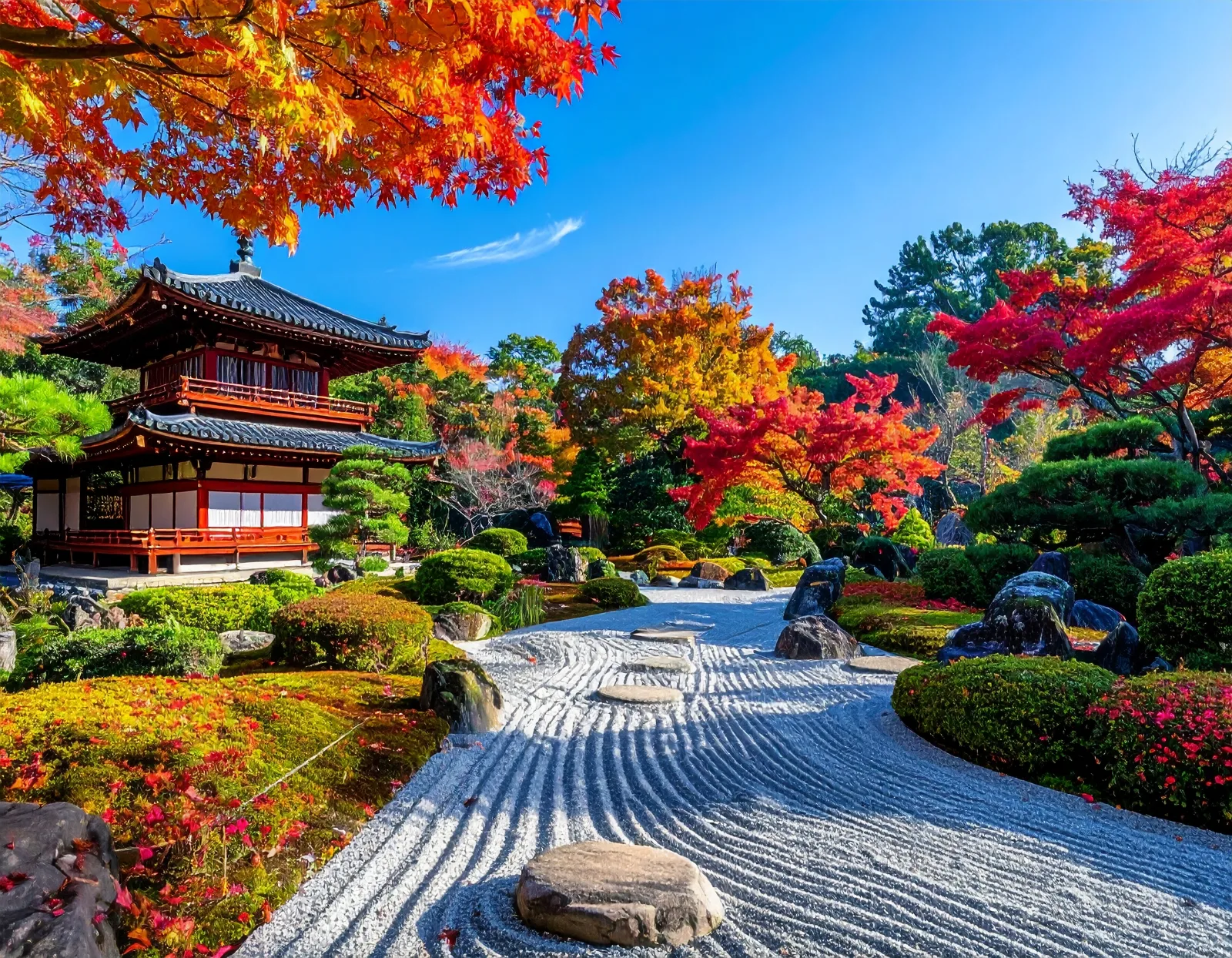
Kansai's other cities each have their own notable gardens -- temple grounds around Nara, strolling gardens in Kobe, castle grounds in Wakayama -- but no single city in the region packs four contrasting styles within such easy reach of each other as Kyoto does. Four Kyoto gardens reward a single day together precisely because none of them look alike. Saihoji, better known as Koke-dera or the Moss Temple, is built around a carpet of over a hundred moss varieties spreading beneath maples and pines. Ryoanji holds Japan's most famous karesansui, a dry rock garden of raked gravel and fifteen stones arranged so that one is always hidden from view. Tofukuji trades stone for color, its Tsutenkyo bridge suspended over a valley that turns deep red and gold in autumn. Ginkakuji, the Silver Pavilion, pairs a sand cone garden with a moss hillside path in the classic Muromachi style. Rather than ranking these four by beauty, the more useful question is how well their styles complement each other in one itinerary -- moss, stone, foliage, and sand, each a different lens on the same tradition.
Public Transit vs. Chartered Bus: How Long It Really Takes to See Several Gardens
Reaching any one of these gardens by public transit is straightforward on its own:
- Saihoji: Kyoto Bus route 73 or 83 from Kyoto Station to the "Koke-dera, Suzumushi-dera" stop, about an hour, then a two- to three-minute walk to the gate (or the Hankyu Arashiyama Line's Kamikatsura Station, a 15-minute walk in the other direction).
- Ryoanji: city bus route 59 from Sanjo-Keihan Station, roughly 40 minutes, or the Randen (Keifuku) Kitano Line's Ryoanji Station, a 7- to 10-minute walk from the gate.
The trouble starts once you add a second or third garden. Waiting for connecting buses and walking between stops eats into the day quickly, and a one-day transit pass -- genuinely good value for a solo traveler or a couple moving at their own pace -- starts to work against a group trying to see several gardens in daylight hours. A chartered bus does not follow a fixed timetable or route, so the order and pacing of stops can be built around the group rather than around a bus schedule.
Getting a Group and a Bus Inside: Parking, Reservations, and Capacity Limits
Each of these gardens has its own rules for groups, and they are worth knowing before the day arrives rather than at the gate:
- Saihoji: advance reservation only, with no walk-in entry. Applications are made by return postcard or online well ahead of the visit, and an application fee applies -- this is a temple-run process, so please confirm the current procedure and fee on Saihoji's official site before applying.
- Tofukuji: parking arrangements for tour buses change during the autumn foliage season, so the drop-off point is confirmed in advance when planning the route.
- Ginkakuji: special viewings may have group-size limits, so larger parties should confirm in advance. Most visitors complete the standard garden viewing in about 30 to 45 minutes.
Working out these reservations, parking assignments, and capacity limits in advance is what keeps a group day running on schedule rather than around it. The entrance fee at each of these gardens buys more than a walk-through: at Saihoji the visit includes a brief temple observance before entering the garden (please check the current format on the official site), and at Ryoanji, Tofukuji, and Ginkakuji it buys unhurried time inside a space designed to be studied slowly rather than passed through -- the difference a raked gravel garden makes when no one is rushing toward the exit.
A One-Day Garden Route Designed for Seniors and Larger Groups
A comfortable route starts by being honest about how long each stop actually takes:
- Tofukuji: the walk around the Tsutenkyo bridge takes about an hour under normal conditions, but on a busy autumn weekend, congestion alone can stretch that wait to two or three hours -- worth building into the schedule rather than discovering on the day.
- Ginkakuji: a shorter stop, with most visitors finishing the garden path in 30 to 45 minutes, which makes it easier to pair with a relaxed lunch stop nearby.
For a group that includes older travelers, spacing these two very different paces apart, adding a seated rest between them, and arranging lunch somewhere within easy walking distance all matter more than trying to add a fifth garden to the day. This kind of pacing is where planning the itinerary around a chartered bus helps: because the route isn't built against a public transit timetable, the time budgeted for each stop can be set generously at the planning stage, well before the day of the visit, rather than squeezed to match a bus schedule -- and the route above is offered as one proposed way to combine the four gardens, not a fixed package. As with any of our itineraries, pricing is arranged as a custom quote based on group size and the exact itinerary rather than a flat rate.
Please note that a Japanese-speaking party leader must accompany the group on board.
When to Visit for the Best Light and the Smallest Crowds
Kyoto's maples typically reach peak color during the autumn foliage season, in the weeks that run from mid-autumn toward the start of winter, and that window is naturally when Tofukuji's walkways are busiest -- the two- to three-hour waits mentioned above are almost entirely a function of timing rather than the garden itself. A few ways to soften that:
- Visit in the early morning, before the main flow of day-trippers arrives -- this noticeably thins the crowds at any of these four gardens.
- Some temples also open for special evening or extended viewing hours by advance reservation during the season, which is worth checking, since these slots tend to be calmer than a midday visit.
For a group traveling together, choosing the right hour of the day does more to protect the experience than choosing the right day of the week -- arrive early, and the same garden that draws a crowd by noon can feel almost private. For more route ideas, browse our sample group itineraries, or request a custom quote for your group.
